文件待客户提供
说明书COAMSDS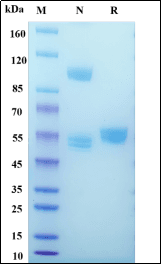
Recombinant Human TL1A Protein, hFc
TNF-like cytokine 1A (TL1A) and its receptors, death receptor 3 (DR3) and decoy receptor 3 (DcR3) are members of the TNF and TNF receptor superfamilies of proteins, respectively. Binding of APC-derived TL1A to lymphocytic DR3 provides co-stimulatory signals for activated lymphocytes. DR3 signaling affects not only the proliferative activity of and cytokine production by effector lymphocytes, but also critically influences the development and suppressive function of regulatory T-cells. Whereas, DcR3 restricts the function of the TL1A/DR3 complex: attenuating T-cell activation and downregulating the secretion of pro-inflammatory cytokines. Together with DR3 and DcR3, TL1A constitutes a cytokine system that actively interferes with the regulation of immune responses.
| 分子别名(Synonyms) | TL1A, VEGI, TNFSF15 |
|---|---|
| 蛋白结构及表达系统(Protein Construction & Source) | ·(Uniprot: O95150-1) Recombinant Human TL1A Protein is expressed from HEK293 cells with hFc (IgG1) tag at the N-terminus. It contains AA Leu 72- Leu 251. ·The protein has a predicted MW of 50.2 kDa. The protein migrates as 55 kDa when calibrated against under reducing (R) condition (SDS-PAGE) due to glycosylation. |
| 内毒素(Endotoxin) | < 0.1 EU per ug as determined by the LAL method. |
| 纯度(Purity) | > 90 % as determined by SDS-PAGE. |
| 浓度及缓冲液(Concentration & Formulation) | ·1.65 mg/mL·Filtered through a 0.22 μm filter, stored in 25 mM Sodium Citrate, 1x PBS, pH 7.4. |
| 运输及储存(Transportation & Storage) | ·This product is shipped under low-temperature conditions. Avoid repeated freeze-thaw cycles during handling.·Protein solution can be stored at 2-8°C for 2-7 days.·Samples are stable for 3 months from date of receipt at -20℃ /-80℃. ·Recommend to aliquot the protein into smaller quantities for optimal storage. |
| 靶点背景 | TNF-like cytokine 1A (TL1A) and its receptors, death receptor 3 (DR3) and decoy receptor 3 (DcR3) are members of the TNF and TNF receptor superfamilies of proteins, respectively. Binding of APC-derived TL1A to lymphocytic DR3 provides co-stimulatory signals for activated lymphocytes. DR3 signaling affects not only the proliferative activity of and cytokine production by effector lymphocytes, but also critically influences the development and suppressive function of regulatory T-cells. Whereas, DcR3 restricts the function of the TL1A/DR3 complex: attenuating T-cell activation and downregulating the secretion of pro-inflammatory cytokines. Together with DR3 and DcR3, TL1A constitutes a cytokine system that actively interferes with the regulation of immune responses. |
|---|
仅供科研使用。不可用于临床诊断、治疗或人体。
告诉我们预期应用与现有起始材料,我们会评估可行性、匹配合适的技术路线,并给出定制报价,通常一个工作日内由科学家直接回复。