文件待客户提供
说明书COAMSDS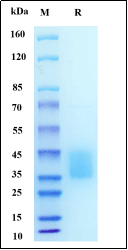
Recombinant Cynomolgus macaque PD1/CD279 Protein, Avi-His
PD1 (PD-1, CD279, PDCD1) is a CD28/CTLA-4-family type-I transmembrane inhibitory receptor induced in activated T, B, myeloid cells and thymocyte populations. It interacts with two B7‑family ligands: IFN-γ-upregulated PD-L1 and DC-enriched PD-L2 found in certain tumours. PD1 ligation represses PI3K/AKT-dependent T-cell proliferation and cytokine secretion, and impairs BCR signalling through downstream transducer dephosphorylation. PD-L1-Ig inhibits anti-CD3-stimulated T-cell responses in vitro. Anti-PD1 therapeutic antibodies relieve this checkpoint-mediated suppression and are being developed for cancer immunotherapy.
| 分子别名(Synonyms) | PD1, CD279, PD-1, PDCD1, SLEB2 |
|---|---|
| 蛋白结构及表达系统(Protein Construction & Source) | ·Recombinant Cynomolgus macaque PD1 Protein is expressed from HEK293 cells with Avi-His tag at the C-terminus. It contains AA Leu 25 - Gln 167.·The protein has a predicted MW of 19.5 kDa. The protein migrates as 35-45 kDa when calibrated against under reducing (R) condition (SDS-PAGE) due to glycosylation. |
| 内毒素(Endotoxin) | < 0.1 EU per ug as determined by the LAL method. |
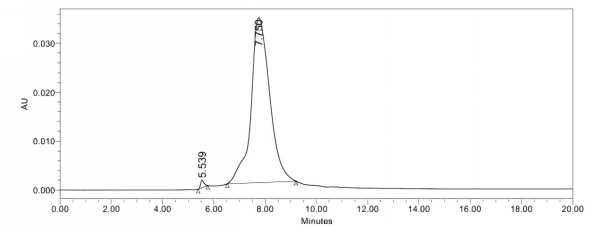
| 纯度(Purity) | > 95 % as determined by SEC-HPLC. |
| 浓度及缓冲液(Concentration & Formulation) | ·1.88 mg/mL·Filtered through a 0.22 μm filter, stored in 1x PBS, pH 7.4. |
| 运输及储存(Transportation & Storage) | ·This product is shipped under low-temperature conditions. Avoid repeated freeze-thaw cycles during handling.·Protein solution can be stored at 2-8°C for 2-7 days.·Samples are stable for 3 months from date of receipt at -20℃ /-80℃. ·Recommend to aliquot the protein into smaller quantities for optimal storage. |
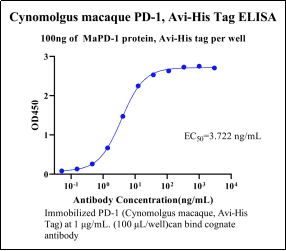
| 靶点背景 | PD1 (PD-1, CD279, PDCD1) is a CD28/CTLA-4-family type-I transmembrane inhibitory receptor induced in activated T, B, myeloid cells and thymocyte populations. It interacts with two B7‑family ligands: IFN-γ-upregulated PD-L1 and DC-enriched PD-L2 found in certain tumours. PD1 ligation represses PI3K/AKT-dependent T-cell proliferation and cytokine secretion, and impairs BCR signalling through downstream transducer dephosphorylation. PD-L1-Ig inhibits anti-CD3-stimulated T-cell responses in vitro. Anti-PD1 therapeutic antibodies relieve this checkpoint-mediated suppression and are being developed for cancer immunotherapy. |
|---|
仅供科研使用。不可用于临床诊断、治疗或人体。
告诉我们预期应用与现有起始材料,我们会评估可行性、匹配合适的技术路线,并给出定制报价,通常一个工作日内由科学家直接回复。